
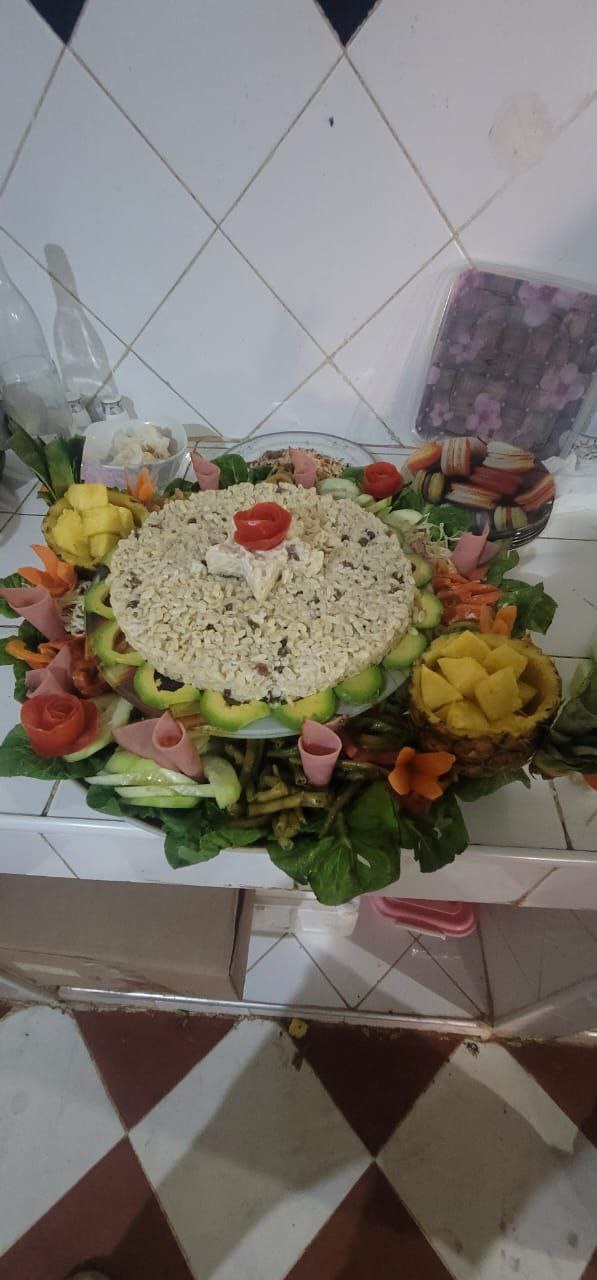
✨ Full Article: “Edible Elegance”
Where food becomes poetry, and every bite tells a story of celebration…
In the heart of Moroccan hospitality, there exists a tradition that transcends mere nourishment. It is the art of the platter—a canvas of abundance, a mosaic of flavor, a visual symphony that speaks of generosity, joy, and the sacred act of gathering.
This is not just food. This is fann al-taqdim—the art of presentation.
The Language of Abundance To prepare a Moroccan celebration platter is to speak a language of love. It is a gesture that says: You are welcome. You are honored. You are cherished. The platter is not minimalist—it is maximalist in the most elegant way. Every curve, every garnish, every rose-shaped tomato is a whisper of care.
The centerpiece, often a salad of shredded chicken or tuna, is humble in origin but elevated through detail. Creamy, tangy, spiced just enough to awaken the palate. It is shaped into a dome or ring, then crowned with a tomato rose—a symbol of beauty and bloom.
The Geometry of Garnish Around this center, the platter unfolds like a garden. Cucumber slices form petals. Lettuce leaves cradle the edges. Rolled slices of ham or turkey resemble delicate scrolls. Each element is placed with intention, creating balance and rhythm.
The pineapples—halved and hollowed—are filled with golden chunks of fruit, their crowns left intact like royal headdresses. They bring sweetness, color, and a touch of tropical flair. Mint leaves peek out like emeralds. Grapes cascade like jewels.
This is not decoration for decoration’s sake. It is storytelling. It is memory. It is the Moroccan way.
Occasions of Joy Such platters are often seen at weddings, Eid celebrations, baby showers, and family gatherings. They are the first impression—the edible welcome. Guests pause not just to eat, but to admire. Phones are lifted. Compliments are exchanged. The host glows with pride.
